Every insurance agency relies on reporting, but not every agency uses reporting in the same way.
Reporting exists on a maturity curve. At one end, it simply documents what has already happened. At the other, it equips leaders with the insights they need to make faster, more confident decisions that shape future performance.
The difference isn’t the amount of data an agency collects. It’s the maturity of the reporting environment supporting those decisions. As reporting evolves from historical summaries to actionable intelligence, the value it delivers grows with it.
The agencies creating the greatest competitive advantage aren’t necessarily collecting more information. They’re progressing through higher levels of reporting maturity, where every report moves beyond describing performance and begins influencing it.
The Reporting Maturity Model
Reporting evolves. The agencies that create the greatest competitive advantage don’t simply build more dashboards. They progress through four distinct levels of reporting maturity, with each stage delivering greater business value than the one before it.
Level 1: Visibility
The question: What happened?
This is where every agency begins.
Reporting is primarily operational and retrospective. Teams rely on static reports, spreadsheets, and historical data to understand what has already occurred.
At this stage, reporting provides visibility into the business, but little context around why performance changed or what should happen next.
Characteristics:
- Static operational reports
- Spreadsheet-driven reporting
- Historical performance tracking
- Siloed information
- Manual report creation
Success at this level means knowing what happened. The challenge is that knowing what happened rarely changes what happens next. To improve decision-making, agencies need to move beyond reporting history and begin understanding the drivers behind business performance.
Level 2: Understanding
The question: Why did it happen?
This is where reporting becomes more investigative.
Leaders begin exploring trends, comparing performance across time periods, and identifying the factors influencing business outcomes. Instead of simply reviewing numbers, they begin searching for explanations.
This creates valuable context, but context alone doesn’t tell agencies where they should focus their attention next.
- Trend analysis
- Interactive dashboards
- Performance comparisons
- Root-cause investigation
- Improved visualization
Success at this level means understanding why performance changed. The next challenge is deciding which opportunities deserve immediate action.
Level 3: Insight
The question: What does this mean?
This is where reporting starts influencing strategy.
Rather than looking at individual reports, agencies begin connecting information across producers, clients, carriers, renewals, and financial performance to uncover meaningful business opportunities.
Reporting shifts from explaining trends to revealing their impact. Leaders gain a clearer understanding of where opportunities exist and where risks are beginning to emerg e.
- Cross-functional reporting
- AI-assisted exploration
- Opportunity identification
- Predictive indicators
- Business context
Success at this level means knowing where opportunities exist.
But insight alone isn’t enough. Agencies don’t outperform competitors because they have better insight, they outperform competitors because they act on it faster.
Level 4: Decision Intelligence
The question: What should we do next?
This is where reporting becomes a true competitive advantage. Instead of simply identifying trends, reporting actively supports decision-making by helping every stakeholder understand the actions that should follow.
Leaders spend less time validating numbers and more time executing strategy.
- Decision-ready dashboards
- Role-based reporting
- AI-powered exploration
- Shared visibility across the agency
- Faster strategic execution
Success at this level isn’t measured by the number of dashboards an agency creates, it’s measured by how consistently those dashboards drive action.
Accelerating the Journey to Decision Intelligence
Progressing through the Reporting Maturity Model doesn’t require agencies to collect more information. It requires them to unlock more value from the information they already have.
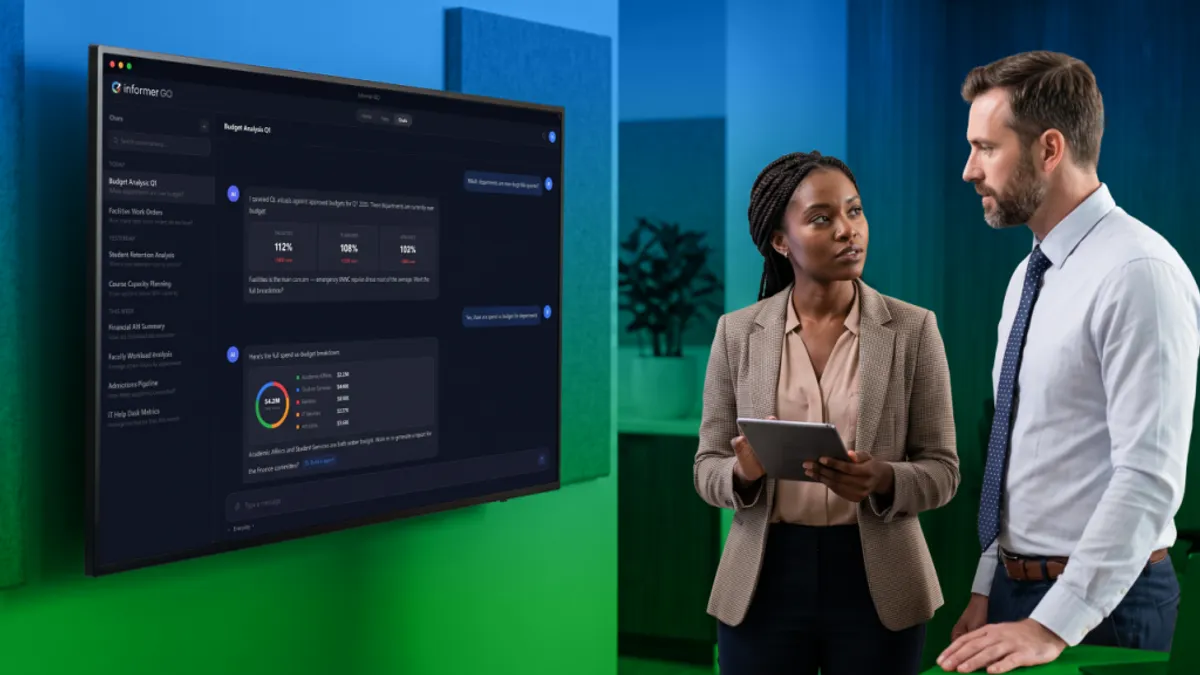
This is where Informer helps agencies accelerate their journey toward Decision Intelligence. Rather than spending hours building reports and manually interpreting disconnected data, Informer enables agencies to explore operational information through AI-powered analytics, interactive dashboards, natural language prompting, and Magic Reports.
Instead of stopping at “What happened?” leaders can quickly uncover why performance changed, identify the factors driving business outcomes, and understand what actions deserve immediate attention.
Role-based reporting ensures producers, operations teams, finance, and executives each receive the insights most relevant to their responsibilities, creating greater accountability and enabling faster, more informed decision-making across the agency.
Informer doesn’t replace the reporting journey. It helps agencies move through it faster, transforming operational data into actionable insight that supports confident decisions.
Reporting Maturity Determines Competitive Maturity
The agencies that create the greatest competitive advantage won’t be the ones producing the most reports. They’ll be the ones that continually advance their reporting maturity until every insight leads to action.
The goal isn’t simply to reach Level Four. It’s to build an agency where reporting consistently drives better decisions, faster execution, and sustainable growth.
Ready to move faster, see further, and work smarter? Let’s talk.