

Insurance agencies have never had more access to information.
Dashboards track renewal performance, producer activity, client retention, carrier profitability, policy growth, commissions, and countless other KPIs. Every department has its own reports, and every leadership meeting begins with another set of numbers.
The assumption seems logical. The more information available, the better the decisions should be.
Yet many agencies are experiencing the opposite.
Instead of creating clarity, reporting is becoming increasingly complex. Leadership teams spend more time reviewing metrics than understanding what those metrics are telling them. The challenge is no longer accessing information. It’s knowing which information actually matters.
Not Every Metric Deserves a Place on the Dashboard
Every metric tells a story. The problem is that not every story changes the outcome.
Many agencies continue adding dashboard metrics every time a new business question arises. Over time, dashboards become crowded with numbers that provide visibility but contribute very little to decision-making. Leadership reviews more information, yet gains less clarity.
This raises an important question.
How do you know whether a metric deserves a place on a leadership dashboard?
The Decision-Ready Metric Framework
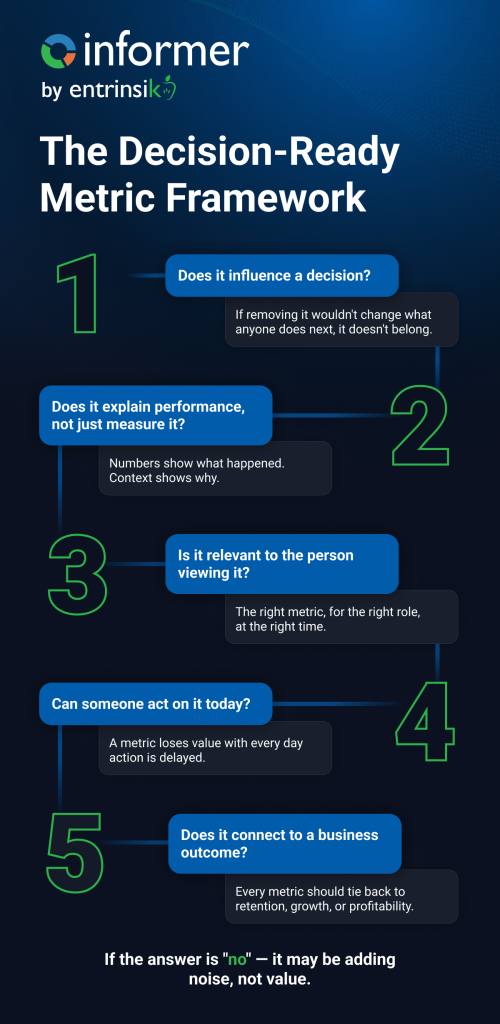
The most valuable metrics have one thing in common. They help people decide what to do next. Before introducing another performance metric to a dashboard, agency leaders should ask five simple questions.
- Does it influence a decision? Every metric should help answer a meaningful business question. If removing the metric wouldn’t change anyone’s decision, it probably doesn’t belong on a leadership dashboard.
- Does it explain performance, not just measure it?Knowing that renewals have declined is useful. Understanding whether the decline is being driven by producer performance, client retention, carrier mix, or servicing challenges is actionable. The best metrics provide context, not simply numbers.
- Is it relevant to the person viewing it?A producer, operations manager, finance leader, and executive all make different decisions. The most effective reporting gives each stakeholder the insights they need to influence their own outcomes rather than overwhelming everyone with the same information.
- Can someone act on it today?The value of a metric decreases every day action is delayed. Decision-ready metrics surface opportunities while there is still time to influence the outcome rather than simply explaining what happened last month.
- Does it connect to a business outcome? Every metric should support a broader objective, whether that’s improving retention, increasing producer performance, strengthening carrier relationships, or driving profitable growth.
If that connection isn’t clear, the metric is probably adding complexity instead of value.
Reporting Should Create Clarity, Not Complexity
This framework represents a shift in how agencies should think about reporting.
The objective isn’t to monitor everything.
It’s to surface the information that helps people make faster, more confident decisions.
When dashboards are built around decision-ready metrics, something important happens. Conversations become more focused. Meetings become shorter. Accountability improves because every stakeholder understands both the performance being measured and the action expected.
Reporting stops documenting activity and starts improving performance.
From Metrics to Meaningful Insight
This is where Informer complements the reporting process. By combining AI-powered analytics, interactive dashboards, natural language prompting, and role-based reporting, Informer helps agencies focus on the metrics that matter most, uncover the drivers behind business performance, and turn operational data into actionable insight.
Because reporting isn’t measured by the number of dashboards an agency creates, it’s measured by the quality of the decisions those metrics enable.
Ready to move faster, see further, and work smarter? Let’s talk.