

You already know you need it. Here’s how to help everyone else see it too.
If you’ve read the first three articles in this series, you’re probably nodding along. You recognize the pain points. You see the gap between where your reporting is and where it needs to be. You understand what a real data strategy looks like on a campus.
But understanding it and getting it funded are two very different things.
Higher ed budgets are tight, scrutinized, and competitive. Every dollar you request is a dollar someone else doesn’t get. And “we need better reporting” isn’t a compelling pitch when the person across the table is weighing it against a new faculty line, a facilities upgrade, or a student mental health initiative.
The good news is that Enterprise BI isn’t a hard case to make. You just have to make it in the right language. Not the language of features and platforms, but the language of time saved, risk reduced, capacity gained, and decisions improved.
This article is a practical framework for building that case at your institution.
Start with the problem, not the product.
The most common mistake in budget justifications is leading with what you want to buy. Nobody approves a line item because a platform has impressive features. They approve it because it solves a problem they already care about.
Before you mention Informer, Enterprise, or any specific tool, document the current state. Be specific. Be honest. Use numbers where you can.
How many hours per week does your team spend on ad hoc report requests? If your IR office has three analysts and each one spends 10 hours a week fielding and fulfilling requests that could be handled by a self-service dashboard, that’s 30 hours a week. Over an academic year, that’s roughly 1,200 hours of analyst time spent on delivery instead of analysis.
How many systems are you pulling data from manually? If producing a single retention report requires exports from your SIS, LMS, and financial aid system, plus manual reconciliation in Excel, document that workflow step by step. Include the time it takes and the number of people involved.
How many times has inconsistent reporting caused confusion or rework? Maybe the provost got two different enrollment numbers from two different offices because the reports were built with different parameters. Maybe an accreditation document had to be rebuilt because the formatting didn’t match institutional standards. These aren’t just inconveniences. They’re credibility issues.
What decisions are being delayed because data isn’t available fast enough? This is the hardest one to quantify but often the most persuasive. If your enrollment management team can’t see yield rates in real time during recruitment season, what does that cost in missed opportunities to intervene?
Build your case around these realities. When the person reading your proposal recognizes their own frustrations in your problem statement, you’ve already done most of the work.
Frame the investment in terms they care about.
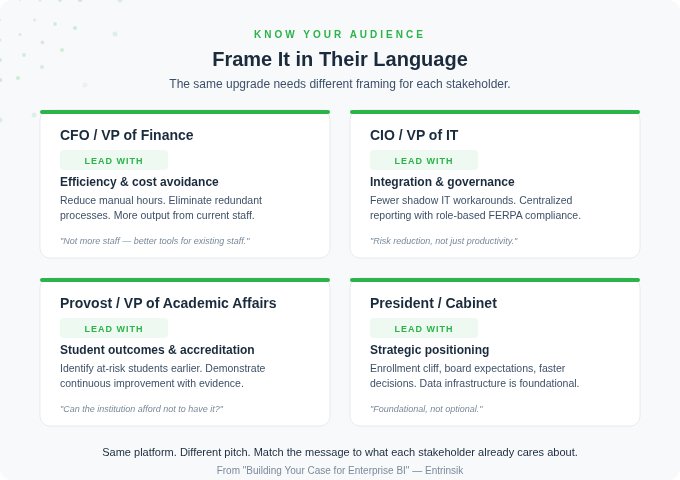
Different stakeholders speak different languages. The same upgrade needs to be positioned differently depending on who’s approving it.
For the CFO or VP of Finance: Focus on efficiency and cost avoidance. Enterprise BI reduces manual labor hours, eliminates redundant processes, and decreases the risk of errors in financial reporting. Frame it as a capacity investment: you’re not asking for more staff; you’re asking for tools that make your current staff more effective. If you can estimate the hourly cost of analyst time spent on manual reporting and multiply it by the hours you’d save, that number often makes the case on its own.
For the CIO or VP of IT: Focus on integration, security, and scalability. Enterprise BI with full API access means fewer point-to-point integrations to maintain, fewer shadow IT workarounds (those rogue spreadsheets everyone pretends don’t exist), and a centralized, governed reporting layer with role-based permissions. For a CIO worried about FERPA compliance and data sprawl, consolidating reporting into a platform with built-in governance is a risk reduction argument, not just a productivity one.
For the Provost or VP of Academic Affairs: Focus on student outcomes and institutional effectiveness. Enterprise BI connects the data needed to identify at-risk students earlier, track retention interventions, and demonstrate continuous improvement to accreditors. For a provost preparing for a site visit or building a student success initiative, the question isn’t whether better data visibility is worth the investment. It’s whether the institution can afford not to have it.
For the President or Cabinet: Focus on strategic positioning. The enrollment cliff, increased accountability from governing boards, rising expectations from students and families. All of these require the institution to make faster, more informed decisions. Enterprise BI is the infrastructure that supports that. Position it as foundational, not optional.
Build the ROI narrative.
You may not be able to produce a precise ROI calculation, and that’s fine. Technology investments in higher ed don’t always come with clean return-on-investment math. But you can build a narrative that makes the value obvious.
Time savings. Estimate the hours your team currently spends on manual reporting, data reconciliation, and request fulfillment. Even conservative estimates tend to be striking. If Enterprise BI cuts that time in half, what could your team do with those recovered hours? More strategic analysis. Better support for accreditation. Faster response to leadership requests. Proactive identification of enrollment or retention trends instead of reactive reporting after the fact.
Risk reduction. Inconsistent data, FERPA exposure from uncontrolled spreadsheets, and manual errors in compliance reporting all carry institutional risk. You don’t have to assign a dollar value to a FERPA violation to make the point that reducing that exposure has real value. And for institutions approaching accreditation, the cost of being underprepared is measured in sanctions, probation, or reputational damage.
Capacity without headcount. This is often the most compelling argument in a tight budget environment. Enterprise BI doesn’t replace people. It amplifies them. A three-person IR office with self-service dashboards, AI-assisted visuals, and automated data integration can serve the same volume of requests that would otherwise require five or six people doing everything manually. You’re not asking for more bodies. You’re asking for better tools for the bodies you already have.
Decision speed. Faster access to better data means faster decisions. During enrollment season, that could mean intervening on a declining admit pool weeks earlier than you would have otherwise. During budget planning, that could mean identifying a shortfall before it becomes a crisis. The value of speed is hard to quantify, but easy to illustrate with examples your leadership will recognize.
Address the objections before they come up.
Every budget request faces resistance. Anticipating the pushback and addressing it in your proposal shows you’ve thought it through.
“We already have a reporting tool.” Yes, and it’s served you well. But the demands on your data have grown beyond what standard reporting was designed to handle. This isn’t about replacing what you have. It’s about expanding its capabilities to match where the institution needs to go. If you’re already using Informer, Enterprise is a tier upgrade within the same platform, not a new system to implement, train on, or migrate to.
“We can’t afford it right now.” Reframe the question: can you afford the status quo? Add up the analyst hours spent on manual work, the cost of inconsistent reporting during accreditation, the risk exposure from ungoverned data access, and the opportunity cost of decisions delayed by slow data. The investment in Enterprise BI is almost always smaller than the cost of continuing without it.
“Our team doesn’t have time to implement something new.” Because it’s a tier upgrade within Informer, not a net-new platform, the implementation lift is significantly lighter than adopting a new system. Your existing reports, datasets, and configurations carry forward. You’re adding capabilities on top of a foundation your team already knows.
“How do we know people will actually use it?” Start with one high visibility use case. An enrollment dashboard for the admissions team. A board reporting template for the president’s office. A retention dashboard for student success. When one group sees the value and starts relying on it, adoption spreads organically. You don’t need to roll out everything at once.
Structure your proposal.
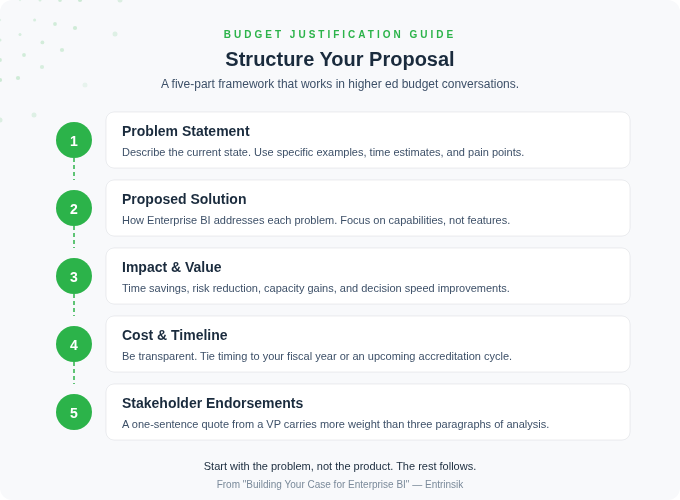
If you need to put a formal document together, here’s a framework that works well in higher ed budget conversations:
- Problem Statement (1 page).Describe the current state of reporting on your campus. Use specific examples, time estimates, and pain points. Make the reader feel the problem before you offer the solution.
- Proposed Solution (1 page).Describe what Enterprise BI provides and how it directly addresses each problem youidentified. Keep it capabilities-focused, not feature-focused. “Self-service dashboards that reduce ad hoc requests” lands better than “interactive dashboard module with drag-and-drop widgets.”
- Impact and Value (1 page).Time savings estimates, risk reduction, capacity gains, and decision speed improvements. Use ranges if youdon’t have exact numbers. “We estimate 15-20 hours per week in recovered analyst time” is more credible than a precise number that looks manufactured.
- Cost and Timeline (half page).Be transparent about the investment. Include any implementation support, training, or phased rollout plans. If you can tie the timing to a fiscal year boundary or an upcoming accreditation cycle, that creates natural urgency.
- Stakeholder Endorsements (half page).If a dean, VP, or department head has expressed frustration with the current reporting model,include their perspective. A one-sentence quote from the VP of Enrollment saying “I need real-time visibility into our admissions funnel” carries more weight than three paragraphs of your analysis.
Timing matters.
When you bring this forward is almost as important as how you frame it. A few timing considerations for higher ed:
Budget planning season. At most institutions, this is late winter through spring for the upcoming fiscal year. If your fiscal year starts July 1, getting your proposal in front of decision-makers by February or March gives it the best chance of being included in the budget rather than treated as an off-cycle request.
Pre-accreditation. If your institution has a site visit within the next 18-24 months, the urgency argument practically writes itself. Framing Enterprise BI as accreditation infrastructure, not just a reporting upgrade, shifts it from “nice to have” to “we need this in place before the visit.”
Post-audit or post-incident. If your institution recently experienced a data inconsistency, a compliance finding, or an embarrassing moment caused by slow or inaccurate reporting, the window to propose a solution is wide open. Nobody wants to fix the same problem twice.
End of fiscal year. If there’s remaining budget that needs to be allocated before June 30, an Enterprise upgrade is a relatively low-cost investment that can be positioned as using existing funds rather than requesting new ones.
You don’t have to do this alone.
Building a budget justification is easier when you have a partner who understands both the platform and the higher ed context. The Informer team has helped institutions of all sizes navigate this exact conversation, from small private colleges to large state university systems.
If you’re putting a case together and want help with cost estimates, use case examples, or even a co-presentation to your leadership team, that’s what we’re here for.
Ready to build your case?
Talk to our team and we’ll help you put together a proposal tailored to your institution, your budget cycle, and your stakeholders.
This is Part 4 of our “Beyond Reports” series for higher ed.
Previously: “7 Signs You’ve Outgrown Standard Reporting“ and “5 Things Your Campus Reporting Tool Should Do That It Probably Doesn’t,” and “From Reports to a Data Strategy: What Enterprise BI Looks Like in Higher Ed.”